The Heart and Soul of Social Good—Part 1: Understanding the Field

[US History Uncovered, 1966]
With so many ways to think about social good, can these ideas get us to where we need to go?
It may go without saying that “social good” is the goal of most nonprofit organizations, philanthropies, community organizations and is an integral part of what local, state, and federal governments intend to do—i.e. benefit society. While the concept of social good may seem relatively new (the specific term “social impact” has been around since the 1970s; see Freudenburg 1986) the heart and soul of social good is, of course, the human experience itself. In essence, it would be strange to think about an individual or a collective effort not striving to impact the world for good.
So, if social good is an innately human experience and the idea itself is not new, what is?
Perhaps the most notable change is its popularity. Widespread use of the term “social good” (and its analogs) has grown immensely. To illustrate, we did a quick analysis with Google Trends. Across a wide variety of related terms, we find a nearly uniform three-fold increase in popularity over the past 20 years, with few regional variations.
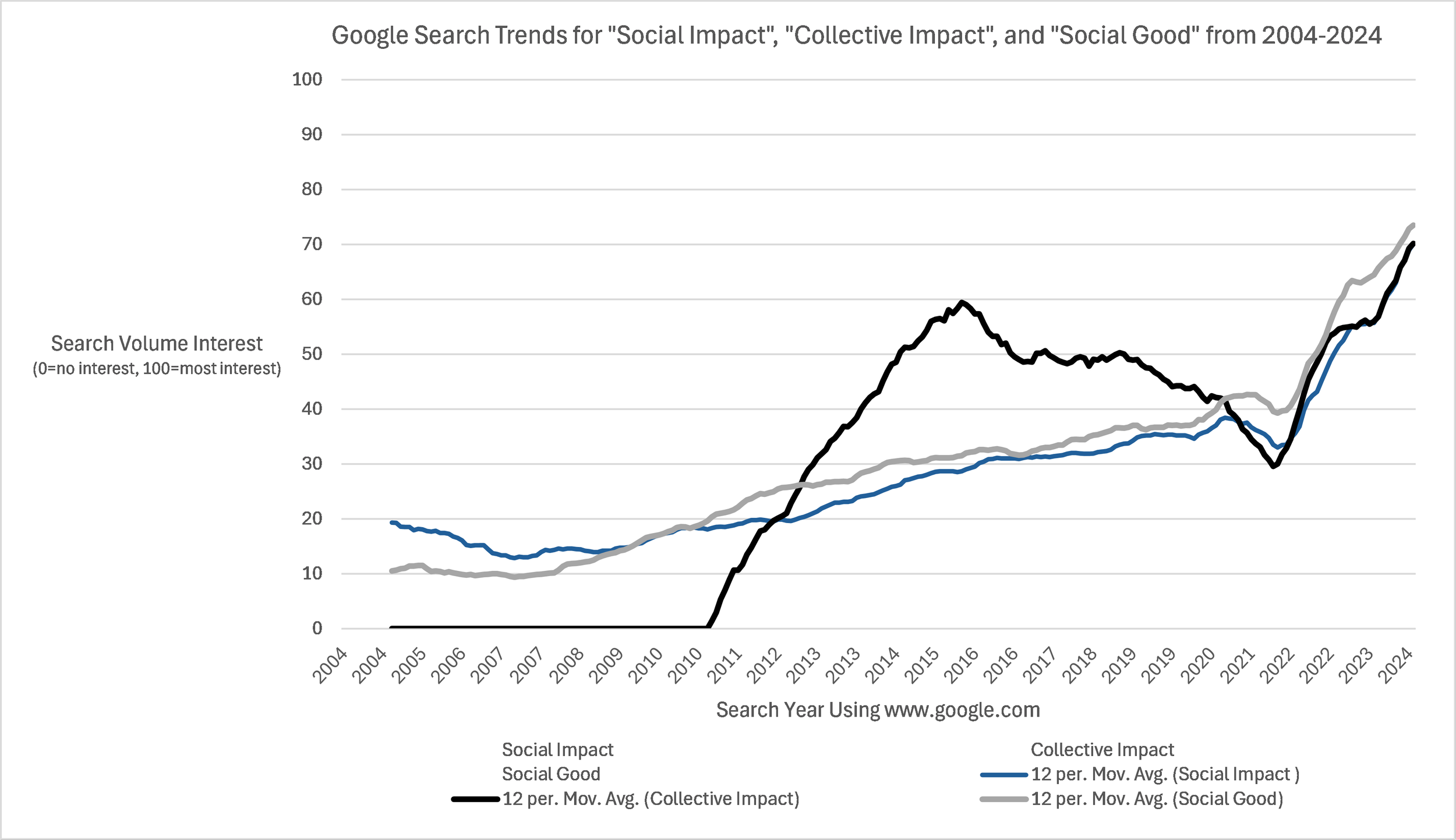
But this interest has led to contested space where many actors (organizations, thought-leaders, scholars, governments, entrepreneurs, institutes, governments, etc.) are all vying to lead, define, and promote their version/vision of social good.
Thus, despite the profusion of ideas about what social impact is, clarification is still desperately needed regarding some of this important field’s most relevant questions. In a step toward such clarity, we will attempt to organize the sprawl of social-impact-related concepts into three related layers—ideas, practices, and innovations.
Ideas
Social good ideas are not new, they have philosophic foundations (e.g. enlightened self-interest, altruism, humanitarianism, communitarianism, utilitarianism, social contract, veil of ignorance, equality of opportunity, capability development) and employ common principles (e.g. selflessness, charity, compassion, equality, equity) with newly developed concepts (e.g. social impact, common good, collective impact, “people first”, social approach).
“Social good ideas are not new, they have philosophic foundations and employ common principles with newly developed concepts.”
These newer concepts stem largely from public concern over for-profit firms and other actors creating externalities that negatively impact society in unchecked ways. From this movement, developed mostly in the 1970s (see Freudenburg 1986), there emerged a public desire for regulations to prevent harm, and more recently, a public appetite to invest in companies that promote good.
New concepts about promoting social good come mostly from for-profit companies seeking to show how their efforts addressed social and environmental needs in an era of Environmental, Social and Governance (ESG). Terms such as “social responsibility,” “social sustainability,” “environmental impact,” “sustainable behavior,” and “responsible investing” have proliferated, most notably in the past three years (2021-2024) (see Google Trends).
Practices
With this movement, an array of innovative assessments and practices have emerged to ensure social good. These ideas have translated directly into practice—social impact-oriented companies often take on initiatives that mirror nonprofit and philanthropic organizations (see Child 2014 & Child 2015) using monikers such as “impact-first,” “impact-focused,” or “operational impact,” and describe their corporate missions based on “sustainability frameworks,” “social impact strategy,” or “sustainable strategies.” Relatedly, a growing number of companies and organizations employ triple-bottom line accounting practices—where social and environmental responsibility are as important as profits (Miller 2020).
Whole new industries around social impact have emerged, most prevalently in the world of finance (e.g. https://sorensonimpactfoundation.org). The challenge of aligning ROI and social impact goals is particularly tangled, and attempts have not escaped critique (see Bildner 2023). Adding to the trouble is the fact that we again find a wide range of terms but often without clear distinctions—terminology like impact investing, responsible investing, social finance, social investing, green finance, impact capital, socially positive investments, social entrepreneurship, social innovation, social ventures, and sustainable finance all inhabit a similar space without much specificity as to the features, goals, and limitations of each.
Innovations

[US History Uncovered, 1964]
Recent innovations include new regulatory oversight, standards, measurement tools, credentials, and collaborations. Based largely on the Corporate Social Responsibility (CSR) movement in the 1970s and 1980s, the Environmental, Social and Governance framework (est. 2004) was developed as an assessment tool for gauging social good of for-profit companies. Likewise, Social Bond Principles (SBP) (est. 2017) set criteria for demonstrating socially responsible investments. Such efforts have inspired new measurement tools (e.g. “impact multiple of money”) and analytic firms to conduct assessments (e.g. QuantumBlack, Y Analytics, Socio) focused on “social return on investment,” “social indicators,” “social and environmental performance,” and “social return.”
New credentials have emerged, such as the nonprofit-led B-Corporation designation and a state-led Benefit Corporation designation, not to mention the numerous available sustainability certifications. There have also been innovative private-public collaborations (e.g. Social Impact Bonds, Pay-for-Success, see Child, Gibbs, and Rowley 2016).
How do we make sense of it all?
Our first task here was simply to organize the field of “social good” into digestible parts by delineating between ideas, practices, and innovations.
But defining terms and organizing ideas isn’t enough, as we are still left with the fractured nature of the movement—leaders have responded within specific sectors (mainly finance and for-profit corporations) and some have collaborated with government, business schools, and philanthropies to define, assess, and promote their version/vision of social good. As a result, it is hard to make sense of the movement as a whole.
We have an idea.
If social good is inherently about understanding the social, perhaps a sociological perspective could help. But there is a problem—we can’t find the sociologists.
In Part 2 of this series we will put “social good” under a sociological lens. We will describe the field of sociology and its relationship to this movement, as well as demonstrate how key ideas in sociology can help build a better understanding of the social good and how organizations can play a more impactful role.
Then in Part 3 we’ll get specific about how a sociological approach can increase the likelihood of positive impact and decrease the likelihood of harm using examples from our own work.
Stay tuned!